The WATTS 210 Automatic Gas Shutoff Valve

THE WATTS 210 AUTOMATIC GAS SHUTOFF VALVE

In this blog, we will be talking about the Watts 210 automatic gas shutoff valve. Most people have never heard of this valve, so we thought it would be a good idea to explain what it is and what it does to help potentially lessen the damage from a malfunctioning water heater.

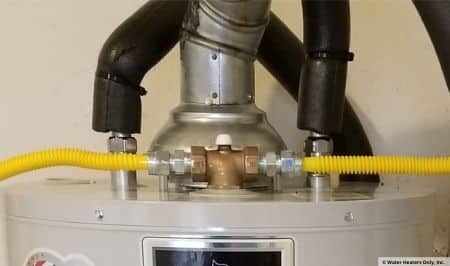
While many are aware of the temperature and pressure relief valve (T&P valve) on their water heater and what it does, the Watts 210 automatic gas shutoff valve isn’t as common and thus isn’t as well known. Basically, the Watts 210 is an immersion-type valve used to protect against overheating water in a water heater. The valve is installed where the T&P would normally be installed on a water heater and it has a thermostat that goes inside the water heater. The gas line is run into the Watts 210 from the gas source and then run from the Watts 210 to the gas control on the water heater.

SO HOW DOES IT WORK?

The Watts 210 is a self-contained device that includes a manual reset button, a trip latch assembly and a thermostat. As we stated earlier, the valve is installed where the T&P valve would normally be installed on the water heater. The thermostat on the valve itself goes into the water heater and is set for 210 degrees. That means that if the temperature of the water in the water heater rises above 210 degrees, the valve shuts off the gas supply to the water heater. This helps to stop the temperature from getting any hotter in the water heater and helps to reduce any further damage to the water heater and possibly even the surrounding area if the water heater failed due to the increased thermal expansion.

As we said, the Watts 210 is installed where the T&P is located and then typically a T&P valve is installed on the cold water line outside of the residence, often right near where an outside faucet may be located. This is done because even though the Watts 210 shuts off the gas, there still needs to be a relief valve located somewhere on the water line to reduce the possibility of damage to the water heater and the water pipes themselves.

At this point, you may be wondering: If the Watts 210 shuts off the gas supply and acts as a T&P, why aren’t they part of a standard installation? The reason is twofold: First, the T&P works just fine as the main source of relief in the case thermal expansion occurs. Second, the part itself is not cheap and involves more labor and time, which can add a substantial amount to a standard water heater installation. The Watts 210 automatic gas shutoff valve is typically used if the T&P line cannot be run to the exterior of the residence as required by many state plumbing codes, especially in California. We often see this when the water heater is located in an inside closet such as in a hallway or the kitchen. In this situation, the water that comes out of the T&P has nowhere to go and can cause water damage if it is a substantial amount of water and goes undetected. In that case, a Watts 210 automatic gas shutoff valve is recommended.

As always, if you have any questions about this subject or your water heater in general, please call us 24 hours a day, seven days a week at 833-379-8800. We are always happy to answer any questions you may have or even schedule an appointment for one of our water heater technicians to come and take a look at your water heater.

AO Smith Water Heater Recall

AO Smith Water Heater Recall Resources

AO Smith Recall Website

Official A.O. Smith Recall Notice

On Nov. 8th, 2018, A.O. Smith announced it had recalled over 600,000 Ultra Low-Nox water heaters due to fire hazard. The fire hazard is due to the burner screen, which can develop tears in it. That can cause the burner to radiate excess heat and that could become a fire hazard for water heaters that are installed directly on floors made of wood or other combustible material.

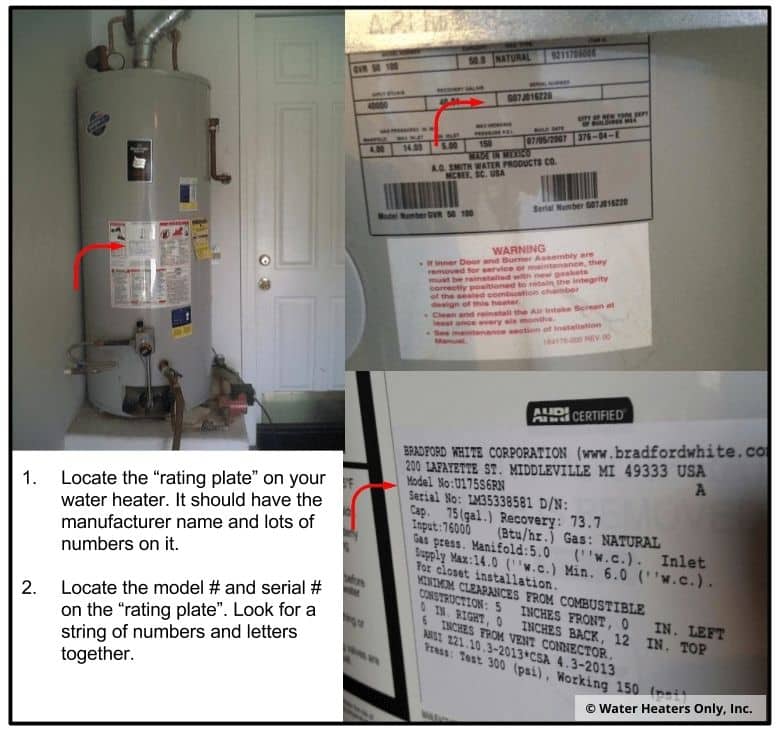
According to the manufacturer, there have been six reports of fires, though no injuries have been reported. The size capacity of the water heaters being recalled are 30, 40 and 50 gallon models that run on natural gas or propane. They were manufactured between April 2011 and August 2016. An easy way to find out if your water heater is affected is to locate the serial number on the rating plate of your water.

How to locate the rating plate

Each rating plate can look a little different. Above is a sample of an A.O. Smith (top) and a Bradford White (bottom) rating plate (Bradford White Water Heaters ARE NOT Recalled).

For the A.O. Smith name brand units, the first four digits in the serial number represent the month and date. For example: a serial number starting with 1115, represents the 15th (April) week of 2011. The digits 1631 would represent the 31st week of 2016 (August). It can get very confusing, but if your serial number’s first four digits fall between those numbers, your water heater may be affected.

If you need help figuring out if your water heater is affected by the recall, go to the A.O. Smith recall website www.waterheaterrecall.com and put in your serial number. This will tell you if your water heater is part of the recall. All brand names manufactured by A.O. Smith are affected. So, it’s not only the serial number that you should be aware of you also want to make sure the brand you have is not part of the recall. See the list below for other brand names affected.

The brand names affected can include:

  • American
  • Whirlpool
  • Kenmore
  • Reliance
  • State
  • U.S. Craftsmaster

What to you do if your water heater has been recalled?

  • Turn off the water heater
  • Contact A.O. Smith
  • Work with A.O. Smith to determine if your unit is affected
  • Schedule a free A.O. Smith recall repair if your unit is affected

A.O. Smith recommends shutting the water heater down immediately by turning the water and gas off to the water heater. Please be aware that a short time after you turn the water heater off, you will not have any hot water. If you need assistance in shutting the water heater down give us a call at 833-379-8800 or follow our emergency shutdown instructions – click here. One of our water heater experts will be happy to help you. Once you have shut the water heater down, contact A.O. Smith. The company states that the issue can be resolved with a repair.

Water Heaters Only, Inc. does not repair the A. O. Smith recalled water heaters – please contact A.O. Smith directly. However, we are happy to help in locating the rating plate and deciphering the serial number of the water heater. For older units that are affected by this recall we can provide a replacement estimate and come out to replace the water heater, if that is preferred. However, we would not be installing another A.O. Smith brand water heater.

If your A.O. Smith water heater is still under warranty, we recommend dealing with A.O. Smith directly. We can not replace any A.O. Smith recalled water heaters under a warranty situation.

Water Heaters Only, Inc is and has been committed to water heater safety for [biz-years] years. You can always email or call us with any questions. We are happy to answer questions, help decipher serial numbers and guide you through the process of having a safe water heater operating in your home.

Water Heater Fire Safety Tips

TOP 5 WATER HEATER FIRE SAFETY TIPS DO’S AND DONT’S

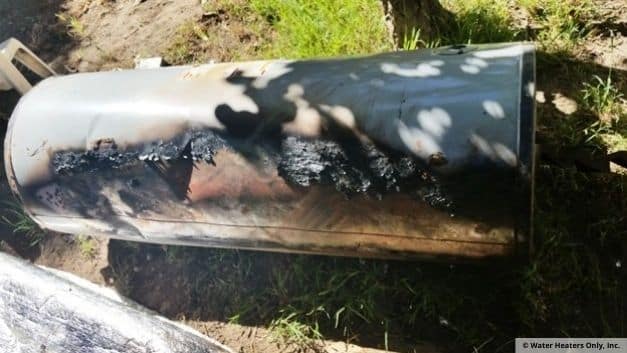
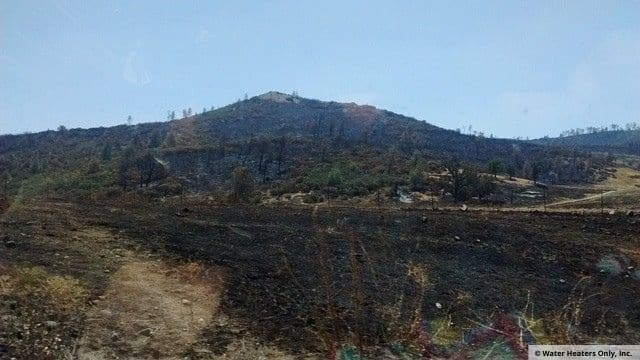
As the California Wildfire Season continues to rage, it was just announced by Cal Fire that the Rocky Fire, which was located in Lake County near Clear Lake in Northern California, was caused by a faulty water heater. The Rocky Fire began on July 29th and burned nearly 70,000 acres over a two-week period and it destroyed 43 homes and caused hundreds of residents to evacuate.

The aftermath of a California wildfire

Evidently, the water heater was located in an outside structure and was surrounded by flammable liquids, which helped cause the fire to really get moving and growing. Read our top 5 water heater fire safety tips and use the best practices to limit possible fire damage caused by your water heater.

California Fire Department on the scene.

Though it may seem unusual that the fire was caused by a faulty water heater, the fact is that hundreds of homes fires have been caused by water heaters in one way or another. According to the National Fire Protection Association, during the 4-year span between 2007 and 2011, water heaters were responsible for 11 percent of fires started by home heating devices. Now, let’s be clear, this doesn’t mean that water heaters are inherently dangerous or some sort of ticking time bomb waiting to catch fire. These facts just remind us that improper use and neglect of your water heater could lead to problems down the road. So, we here at Water Heaters Only, Inc. thought this would be a good opportunity to share some helpful tips that could make all the difference when it comes to keeping you and your family safe from fire danger.

  1. GET YOUR WATER HEATER CHECKED ANNUALLY Most people don’t think about their water heater until they have to, meaning until it stops working or they discover a leak. But it pays to have a professional come over to your home once a year and make sure there are no problems with your water heater and check for any potential problems that might occur in the near future. During this check, something like a small gas leak may be discovered and corrected before it becomes a major fire hazard.
  2. KEEP FLAMMABLE MATERIALS AWAY FROM YOUR WATER HEATER – This cannot be stressed enough, especially in light of the fact that it was reported that the Rocky Fire was caused, in part, by flammable liquids that were kept near the water heater. These were ignited, thus helping to create this huge fire. So, make sure that flammable materials such as oily rags and even paint and gas cans are kept far away from your water heater.
  3. KNOW HOW TO SHUT YOUR WATER HEATER OFF – This is helpful for so many reasons, but it is especially helpful in regards to fire danger and prevention. That’s because if you happen to smell gas or discover a gas leak in your water heater, you will want to get the gas shut off as soon as possible. For complete instructions, go to our main website to watch a very informative video and to get detailed instructions for shutting down your water heater. Just click here. (Insert link here https://waterheatersonly.com/emergency-shutdown-instructions
  4. MAKE SURE THE AREA AROUND YOUR WATER HEATER IS CLEAR FROM DEBRIS – This point is connected to the previous point about flammable materials being stored next to the water heater. In general, the water heater needs “breathing room” so that there is plenty of ventilation available for the pilot assembly to burn properly. If the air flow is cut off by debris and clutter stacked around the water heater, this could cause the heater to not work properly and that could become a fire hazard.
  5. MAKE SURE THE AREA IS ALSO WELL VENTILATED, ESPECIALLY IF THERE ARE FLAMMABLE MATERIALS – Since many water heaters are located in the garage, there is a greater likelihood that the homeowner may use a flammable material in the vicinity at some point. This could be as a result of painting or using varnish or even filling your lawn mower with gas (we recommend you do all of these activities in a different area than your water heater. No matter what the situation, you always want to make sure that the area is well-ventilated so that there is no danger of the fumes combusting and causing a fire.

We hope these water heater fire safety tips has been informative and helped raise awareness about the potential fire hazards that can be avoided with some common sense, preventative measures. If you have any other questions, you can always call us at 833-379-8800 24 hours a day, 7 days a week and talk to one of our water heater experts. You can even arrange to have one of our technicians come out and inspect your water heater for you. And, of course, for more information about water heater safety and water heaters in general, you can always check out our FAQ’s.

By John Heaters Google + |Facebook

Water Heater Failure

Signs of water heater failure

What signs can alert you before water heater failure

A leaking water heater

Most often homeowners aren’t aware that a water heater failure is about to happen. Have you come home to water running from under the garage or a soppy carpet? While you can’t be for sure when your water heater failure will occur, there are signs that you can keep an eye out for.

One of the most important things is to know the age of your water heater. You can find the age of your water heater by looking at the manufacturer sticker on the upper portion of the water heater. It will have the brand name and many different numbers and small symbols. Try to find the serial number or manufacturer date.

This date will not be exactly when your water heater was installed, but it will tell you how old the tank is. The serial number will have a date code for example “F051052638”. F is for the month – F is the sixth letter so it represents the sixth month, June. Next the first two digits of the serial number are 05, this represents the year, 2005. A water heater with the serial number F05052638 was made in June 2005. Each manufacturer has a similar “code date” for their product, some are easier than others to figure out, if you can not figure out the age of your water check the manufacturers website for the way to crack their “code”. Once you know the when you water heater was manufactured you can keep track of how old it. As a rule of thumb most water heaters over 10 years old have lived a useful life can be replaced. If your water heater is in a location that WILL NOT cause damage if leakage occurs, you can wait until it develops a leak before replacing it. However, if your water heater is in a location that WILL cause damage to your home, replace it after 10 years or before if any of the following symptoms occur.

Rusty Water

Rusty water that comes from only the hot side piping in your home can be a sign that your water heater is rusting away from the inside out and will begin to leak in the near future. If you have galvanized piping you may also have rusty pipes. A good test to ensure you are not replacing a functioning water heater, is to drain the few five gallon buckets of hot water out of the water heater. If by the third bucket the water from your water heater is still coming out rusty then most likely it is not the hot water piping, but the water heater. This is a sign that your water heater needs to be replaced.

Rumbling and Noise

As a water heater ages sediment will build up on the bottom of the tank. Overtime the sediment is heated and reheated and as more sediment accumulates it hardens. When this happens you can often hear rumbling or banging sounds coming from the water heater when it is heating up. This is a sign that the water heater it at the end of it’s useful life. First the water heater will have to use more energy (gas or electricity) to heat the water and will be less efficient. Second the extra time spent heating the water will cause more wear on the metal tank and lead to more brittle metal that can crack and develop tiny holes quicker. If you start to heard rumbling from your water heater, keep an eye out for any small leaks, then replace your water heater.

Moisture Around Water Heater

If you notice moisture around your water, you may have a small leak or a fracture in the tank that releases water when the water heater is heating up. As the metal heats it expands, if there are slight fractures sometimes water will leak from the tank. Once the metal has cooled the inner tank will stop leaking. Make sure there are no other leaks coming from the water heater. Check the fittings and connections to the tank. Also make sure the t/p temperature / pressure overflow pipe is not leaking and causing the moisture. If everything all other connections and fittings are dry and the water heater is an older model, it may be time to replace the water heater. You can always look inside the bottom of the water heater and try to see if the inner tank is dripping. It is not always easy to see inside the bottom of the tank, but it’s worth a try before replacing the tank.

If you are concerned about water heater failure or any of the signs above you can call and speak with a water heater expert 24 hours a day 833-379-8800 or check our FAQ’s to read more about common water heater problems.

By John Heaters Google+ | Facebook