IT’S TIME FOR SPRING CLEANING

SPRING CLEANING

Spring is here and that means it’s time for Spring Cleaning! It may not be fun but it feels good when it’s done and it is necessary after a long winter in and especially with all the time most people have spent inside recently. Of course, everyone knows how to deep clean their homes but not everyone thinks of cleaning the outside. So we have a few ideas for cleaning that you may not think of and that can really add some sparkle to your home.

PRESSURE WASHING

Not everyone has a pressure washer, but you can rent one for relatively cheap and it is a great way to clean off areas that may get neglected. Here a few areas that can look much better after a good pressure washing:

  • Driveways
  • Patios and decks
  • The outside walls of your home

As with any tool, make sure to read the directions before use and know that not everything can be pressure washed including electrical light fixtures. Also, know that there is pressure washing and power washing. The difference is that power washing uses heat as well to really help deep clean. Power washing is good for cleaning driveways and cement walkways.
PAINTING

After a good deep cleaning with the pressure washer, nothing helps perk up the outside of your house like a new coat of paint. We know that painting the outside of your home can be a major chore, but most experts recommend repainting your home every 4-6 years depending on where you live. That may not always be feasible, but if it’s been more than 10 years you may want to consider it.

However, if repainting your home is just too big of a task right now, consider other areas that may be in need of a touch up. After pressure washing your deck, it would be a good time to sand it down and add a new coat of weather-resistant paint or stain. Also, consider your formerly white picket fence that is looking a little worse for wear. A cleaned up and freshly painted fence can really make your whole home look brighter.

LANDSCAPING

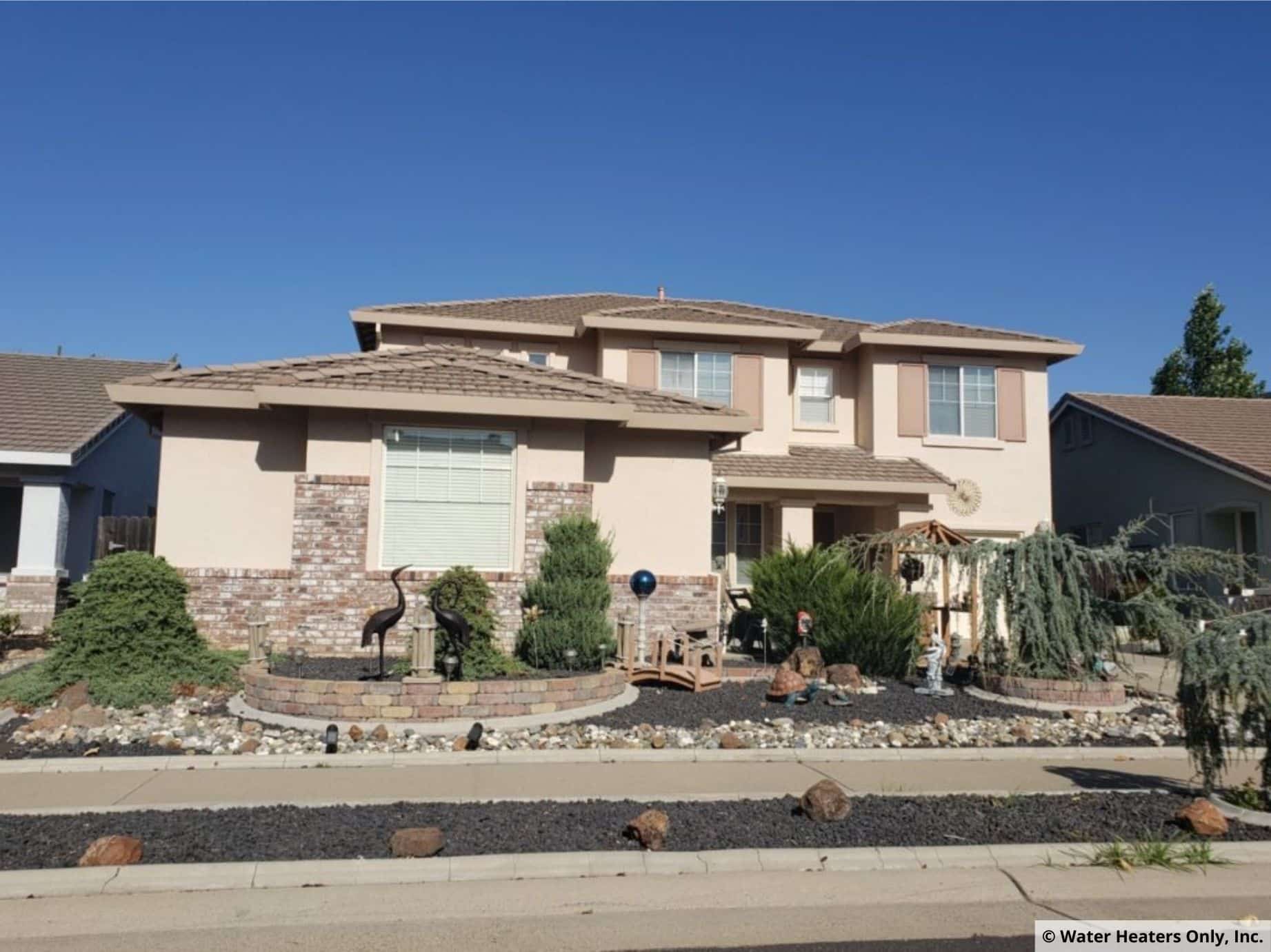
Okay, this may not officially be cleaning, but it’s close and a well-maintained yard just feels and looks nice. And we’re not just talking about mowing the lawn or whacking the weeds, either. Consider adding a water fountain or some new plants that may help to create a nice sitting area. Remember to also find plants that are suited for the climate you live in so that they have the best chance to survive. Maybe add some solar lights along a path or just place some throughout the yard. Trim those crazy long branches and make sure your hedges look good, too. All of these will help make your yard look better and really add some style and “Wow” factor to your home (see top photo for proof).

Hopefully, these outside spring cleaning ideas will help give your home a nice touch-up. Of course, we’re not suggesting you ignore the inside of your home. And while we’re at it, don’t forget about your water heater because we didn’t! We are Water Heaters Only, Inc., so it makes sense that we would mention the water heater. Spring cleaning is a good time to make sure your water heater is clean as well. Check it for dust and rust and also take a moment to check for any small leaks that may have gone unnoticed. Now is also a good time to make sure that there isn’t a bunch of stuff piled up too close to the water heater. This can affect its performance and even be a fire hazard depending on what is stored by it. A three foot clearance is a good start. For more water heater tips, check out our blog here. If you have any other questions about your water heater, don’t hesitate to give us a call 24/7/365. Happy Spring Cleaning!

Interested in learning how to flush your water heater? Click here to learn more about water heater maintenance, or give us a call at [phone-local]
Water Heater Replacement Plumbing Codes

We here at Water Heaters Only, Inc. always make sure we tell our customers that we do all of our jobs “up to code”, but we realize many people don’t always know what that means. The code we are referring to is the California Plumbing Code. If you have ever had to do any major renovation or repair on your home, you likely had to get a permit from the city and that meant you had to follow certain guidelines, or codes, for the work to be done. All incorporated cities have a building inspection and/or code compliance department. If they don’t, then that job will typically fall to the county. Either way, there are codes for just about every type of repair and renovation and that includes water heater plumbing codes.

According to the International Association of Plumbing and Mechanical Officials, the codes “attempt to minimize public risk by specifying technical standards of design, materials, workmanship and maintenance for plumbing systems.” Basically, these codes ensure that all repairs, replacements and installations are safe and effective, whether it’s installing a new bathroom or a water heater. Water Heaters Only makes sure that every one of our technicians are aware of all codes and any recent updates and we make sure to follow these codes as we have been doing now for over 50 years. For a full rundown of the required codes for water heater installations, visit our blog here.

Despite our knowledge of the plumbing codes, we realize that many people aren’t aware of them and so we thought it would be useful to go over some of the plumbing codes in the hopes of educating the public about how and why we go about performing our repairs and installations. However, before we go any further, it should be noted that each city and county can choose to implement these codes in different ways meaning that what is required in one city may not be required in another. It can get a little confusing, which is why it is so important to use a company that is up-to-date on all the latest codes.

CHAPTER 6: WATER SUPPLY AND DISTRIBUTION


PRESSURE REGULATORS

While most of our California Plumbing Code (CPC) blogs will be about information in Chapter 5: Water Heaters (obviously), in this post we will be discussing water pressure and that is covered in Chapter 6, section 608. Just for starters, water pressure is measured in PSI, or pounds per square inch. Whenever we go out to any

a water valve on a water pipe

job whether it is for a repair or an installation, we always check the PSI. This is useful because it can help determine the cause of a problem such as a leak or a water heater failure. According to CPC Section 608.2, whenever water pressure exceeds 80 PSI, a pressure regulator is required if there isn’t already one installed.

A pressure regulator does exactly what it sounds like: it regulates the water pressure in the plumbing. High water pressure can not only damage a home’s plumbing but can also damage a water heater as well. Most homes have one, but not always. If we find a home has water pressure above 80 PSI and there isn’t a pressure regulator, we will always offer to install one. And if there is one but the pressure is still high, we will check to see of the current one has failed. Not only can any water pressure above 80 PSI be detrimental to the water heater and plumbing, it will also void the warranty on most water heaters. For more information about water pressure and pressure regulators, please read our blog here.

EXPANSION TANKS

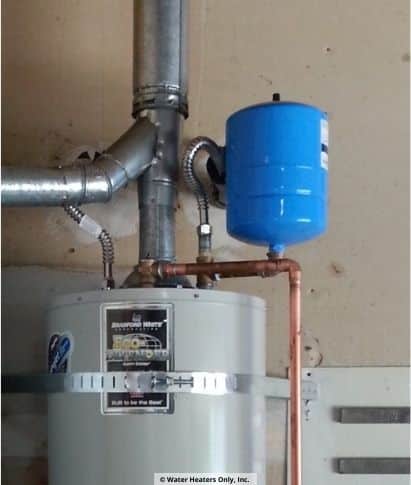
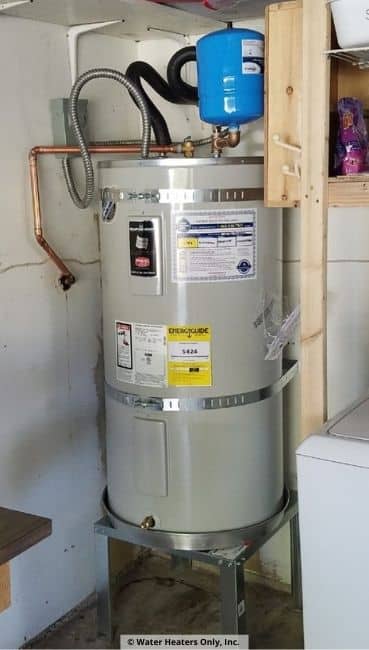
Expansion tanks are an important part of minimizing damage to your water heater and plumbing and they are required in certain situations by the CPC. Basically, an expansion tank is a metal “bottle” that is used to relieve when thermal expansion occurs. The expansion tank had a bladder inside of it and when thermal expansion occurs, the expansion can be relieved temporarily by going into the tank. When the thermal expansion has stopped, the excess water goes back into the plumbing.

a water heater heater with an expansion tank

In the above section about pressure regulators, the CPC states that an expansion tank must be installed when a pressure regulator is installed. That’s because a pressure regulator causes the water to not be able to go back to the city main and is essentially locked into what is known as a “closed loop” plumbing system. It’s a closed loop because the water and thermal expansion, when it occurs, can’t go back to the city’s main water system located outside the home. In Section 608.3, the CPC also states that expansion tank must be installed if there is a check valve, backflow preventer or “other normally closed device that prevents dissipation of building pressure back into the water main”.

PRESSURE RELIEF VALVES

Section 608.3 also mentions the use of pressure relief valves in conjunction with expansion tanks. Not only must an expansion tank be installed when part of a “closed loop system”, there must also be a combination temperature and pressure (T&P) relief valve. For water heaters, these are typically located on the top of the water heater (though not always). Take a look at the picture above if you aren’t sure what the T&P looks like. These relief valves are set to relieve water and pressure after a certain PSI or temperature has been reached. These pressure relief valves need to also have a discharge pipe (Section 608.5), which has its own requirements such as:

  • The discharge pipe should discharge independently by gravity either into the drainage system or to the exterior of the building.
  • It must discharge in such a way that does not cause bodily harm or structural damage.
  • It cannot discharge into a water heater pan.

This is why you will typically see the T&P valve connected to a pipe that runs either alongside the wall to the outside or through the wall where it will be allowed to discharge in a safe place where no one may get hurt.

In conclusion, we hope this has been helpful information. One final note: As we mentioned in the beginning of this blog, each city may decide to implement the plumbing codes differently dependent on the situation. For example, in some areas the city inspector won’t require an expansion tank to be installed as long as there is a working T&P valve present. Also, an inspector may allow a T&P drain line to just discharge to the floor if the water heater is located in the garage. That’s why it’s so important to hire a company that knows the latest codes. For any further questions about water heater plumbing codes or to schedule an appointment with one of our water heater experts, just give us a call 24 hours a day, 7 days a week at 833-379-8800.

Halloween Horror Stories

Truly Terrifying Tales from our Techs!

It’s Halloween time again and that means it’s time for another round of Halloween Horror Stories from our techs in the field. Water Heaters Only, Inc. has been in business since 1968, so we have seen just about every type of water heater situation there is, but sometimes even we get a little spooked by what we find when we check out a water heater. Here are just a few of the creepy and sometimes downright scary water heaters we have seen in the last year:

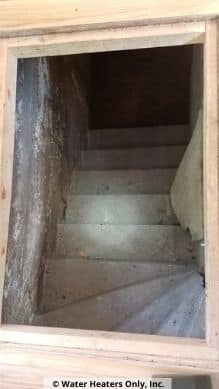
A scary stair way to see the water heater
“I have to go down there?”
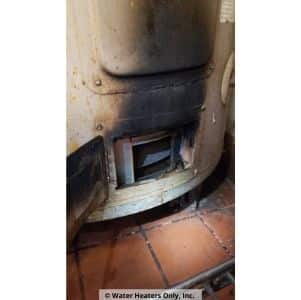
File these under: “I think we found the problem!”
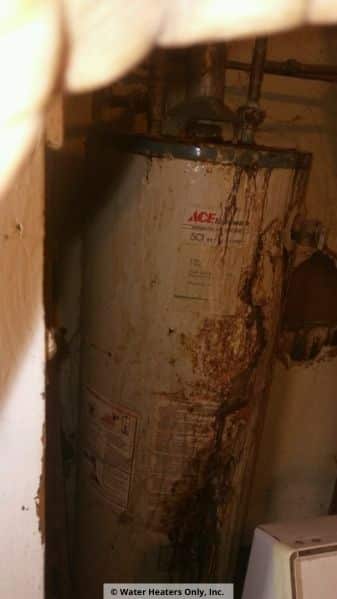
This water heater needs to be replaced. Look at the rust!

The spider webs on the way to this water heater are wild.
“No, YOU out your hand back there!”

So there you have it. Just another small sample of the truly terrifying situations our technicians have to deal with from time to time. We hope you have enjoyed this edition of Halloween Horror Stories, but before we go, we would like to remind you that Halloween is not only the time for spooks and frights, it is also the time when the air turns cold and so does the ground water feeding your water heater. This can lead to water heater issues, especially if your water heater is old or if it is already struggling due to the amount of sediment that has collected in it. Basically, when the water coming into your water heater gets colder, the water heater has to work harder to bring the water up to temperature. Here are a few winter water heater tips to help with this situation:

  • Turn up your thermostat a few degrees. If you do that, make sure you check the temperature at a faucet to make sure it isn’t so hot that someone may get scalded. Also, never turn it up past 140 degrees F.
  • Make sure that the hot and cold pipes attached to your water heater are insulated. You should also consider having any pipes that are under the house to be insulated as well.
  • If you haven’t done so recently, you may consider flushing your water heater to remove the sediment that can accumulate in the water heater. If there is too much sediment, the water heater will have to work harder to heat the water and there will not be as much room in the water heater for the hot water, potentially leaving you at risk of running out of hot water sooner than expected.
  • If your water heater is located in the garage or in an outside shed or closet, check that there aren’t any drafts that could make the ambient air colder than it has to be.

If you have questions about any of these recommendations, please feel free to call us 833-379-8800 24 hours a day, 7 days a week to talk to one of our water heater experts. They can answer any questions you may have or even set up an appointment for one of our technicians to come out and inspect your water heater for you. Until next year, Happy Halloween!

Turn Off The Gas Supply To The Water Heater

How Do I Turn Off The Gas Supply To The Water Heater

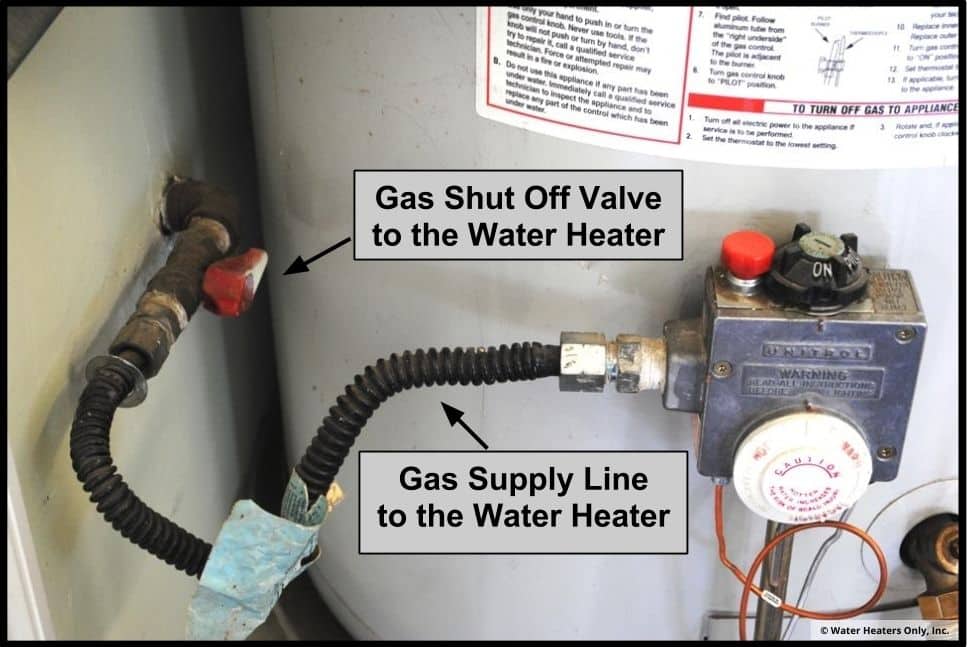
the gas shut off valve to a water heater

How do I turn off the gas supply to the water heater? This is one question we are frequently asked by our customers. It is a great question and one that every homeowner should be educated in, just in case problems arise with their water heater.

You might smell gas coming from your water heater, it might not be performing as usual or it the water heater may be leaking and it would be a good idea to know how to turn off the gas.

The gas can be turned off from the outside gas meter, which shuts off all gas to the house or at the water heater itself, which just turns off the gas supply to the water heater. Knowing how to shut off the gas from both places can really come in handy.

To turn off the gas supply to the water heater:

All appliances that require water or gas have a separate shut of valve usually within a few feet of the appliance. To find a water heaters’ gas shut off valve look for a single handle valve that would usually be located at the bottom of the unit about a foot or two out. The valve will look similar to the one in the image below.

the anatomy of the gas line on a water heater.

Turn this valve in the clockwise position to turn the gas off. If you can’t get the gas valve to turn, can’t find the gas valve, or if there are any other problems, there is a second option which is to turn the gas off to the whole house.

To turn off the gas supply to the whole house:

Finding the gas meter shut off valve can sounds daunting, but it can actually be pretty simple. The gas meter shut off is located right next to the gas meter that is found on the exterior of the house as shown below. The gas valve is on when it is parallel to the incoming gas line. When the valve is turned a quarter turn so that it is perpendicular, then the gas line is closed and the flow of gas is off. Typically, this valve can only be opened and closed with a wrench. In case of emergency or if you smell gas, exit the home and contact your gas provider.

If you are concerned about how to turn off the gas supply to the water heater or any of the signs above you can call and speak with a water heater expert 24 hours a day 833-379-8800 or check our FAQ’s to read more about common water heater problems.

By John Heaters Google + | Facebook

100 Gallon Water Heater

100 Gallon Water Heater

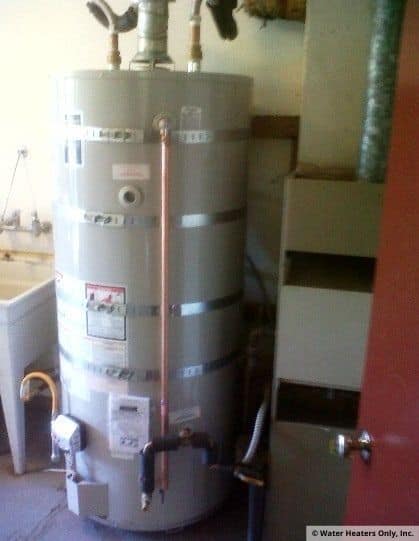
Residential natural gas 100 gallon water heater with recirculation pump

An earthquake strapped 100 gallon water heater.

This residential natural gas 100 gallon water heater is installed with a re-circulation pump to provide instant hot water to the homeowner. As soon as the homeowner opens a faucet or shower in the home hot water comes out.  No more waiting for hot water to arrive while gallons of good water goes down the drain.

Having a re-circulation pump installed with your water heater can make a complete difference with the amount of time you have to wait to receive hot water.

If you own a ranch style home and the hot water has to travel from one end of the home to the other it can take up to 5 minutes for the hot water to reach the faucet or shower. This is a waste of water and energy as the hot water travels through the pipes is loses some of it’s heat, making the water heater work more in the long run.

Benefits from a re-circulation pump are not only convenient they are also financially sound. How often have you stood waiting for the hot water to arrive, thinking “I wish there was a way I could get hot water faster”.

Re-circulating pumps provide the solution to this ongoing problem. Pumps are available in a few different models and styles depending on the existing plumbing you have and the style of your home.

A re-circulation pump can be added to your water heater, if there is a return line for the water to circulate through. If you do not have a return line, most often a little additional plumbing can solve that problem. If you can not have a return line added a different type of re-circulation pump can be added to your water heater, with special valves added to the hot water fixtures in your home. You will be able to have hot water instantly.

In addition to a re-circulation pump, most brands and styles of re-circulation pumps work with timers so you can set the pump to run during your peak water usage hours. This will help save even more energy, by only using the re-circulation pump to circulate the water when you will actually need the hot water at the faucet immediately. No need to have the re-circulation pump running all day if you are away from home. Most often homeowners request we set the timer for early morning and evening hours when hot water is frequently used.

If you have questions about how re-circulation pumps give our water heater experts a call 833-379-8800 and find out what options are available for your home. You can also view our re-circulation pumps product page and find out more about the products and brands we offer.

By John Heaters Google + | Facebook